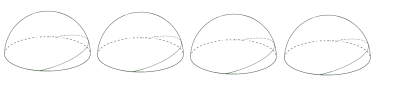
I talked a little with my most veteran player (and sometime DM) about his experience inside the Tumbling Dungeon and what he would need to run it. His first idea was to have a separate map of each state of the dungeon. I told him this is actually what I started with; four maps in my DM folder. It turned out to not help. One reason was that I wanted all my notations (monsters, treasure, corpses) on one map for ease of use while DMing.
But the more fundamental reason was that I had no problem keeping track of how the dungeon moved, but of the orientation of the fixed things within the dungeon. One example is the pedestal in the center of the dungeon that contains the constantly mixing golden elixir. It would be much easier to say it is levitating, suspended in the very center of the dungeon's central room. But if you are saying the whole reason of the dungeon is to mix this elixir, then it needs to be attached to a wall. And then you need to be able to tell the players the pedestal is now on the ceiling, now in front of you, etc.
 |
| Party faces unexplored chambers |
 |
| Party needs to turn around to explore |
I'm sure the ease at which any DM can manage this varies, I had a hard time of it.
I don't know any solution to this other than a digital map on a laptop or a physical model the DM can manipulate behind the screen. I contemplated and almost made a little index card-origami model for myself.
The Sand Room
I would revise the sand room if I ran another party through it. The cool thing about sand is that, unlike water, you can walk across the features it hides and you can't see them. You might hide furniture, daises, thrones, etc. The problem is, that the sand will always find the floor, so these features will only be apparent when they are on the wall or the ceiling, not a very useful place for thrones. What I did was hid a world map, meh. The party wasn't very excited by this and it didn't seem to utilize the full potential of the sand.
Now, I think I would make it hide work benches, anvils, sorting tables-- things that would be useful for thirty minutes at a time and could be attached to the wall. You could have shelves too, as long as they were shuttered and the items inside well-secured.
Again, the whole point for me in tumbling the dungeon was not to try to confuse players, which seems like a much easier task, but to pack more exploration and wonder into the same amount of dungeon space. Having a workshop appear where before there was only a sandy-floored room seems to get at this. Especially if players begin suspecting something interesting might be hidden under the ten feet of sand.
Escape
Because the dungeon is consistent and only has four states it isn't too hard to figure out. My players figured out how to get out in about 30 minutes to an hour of real time in which they were paying close attention to things and trying to map. That being said, with about 15-30 minutes between rotations, it can take some time to ride out the tumbles until the exit becomes usable. So this can play havoc with the idea that a party needs to end a session outside of a dungeon. This didn't cause a lot of problems for me-- I just used dreamlike logic to warp different players in and out of the party when they were present to play. But it might be a hitch if you are using Jeff Rients' table of Dungeon Doom.