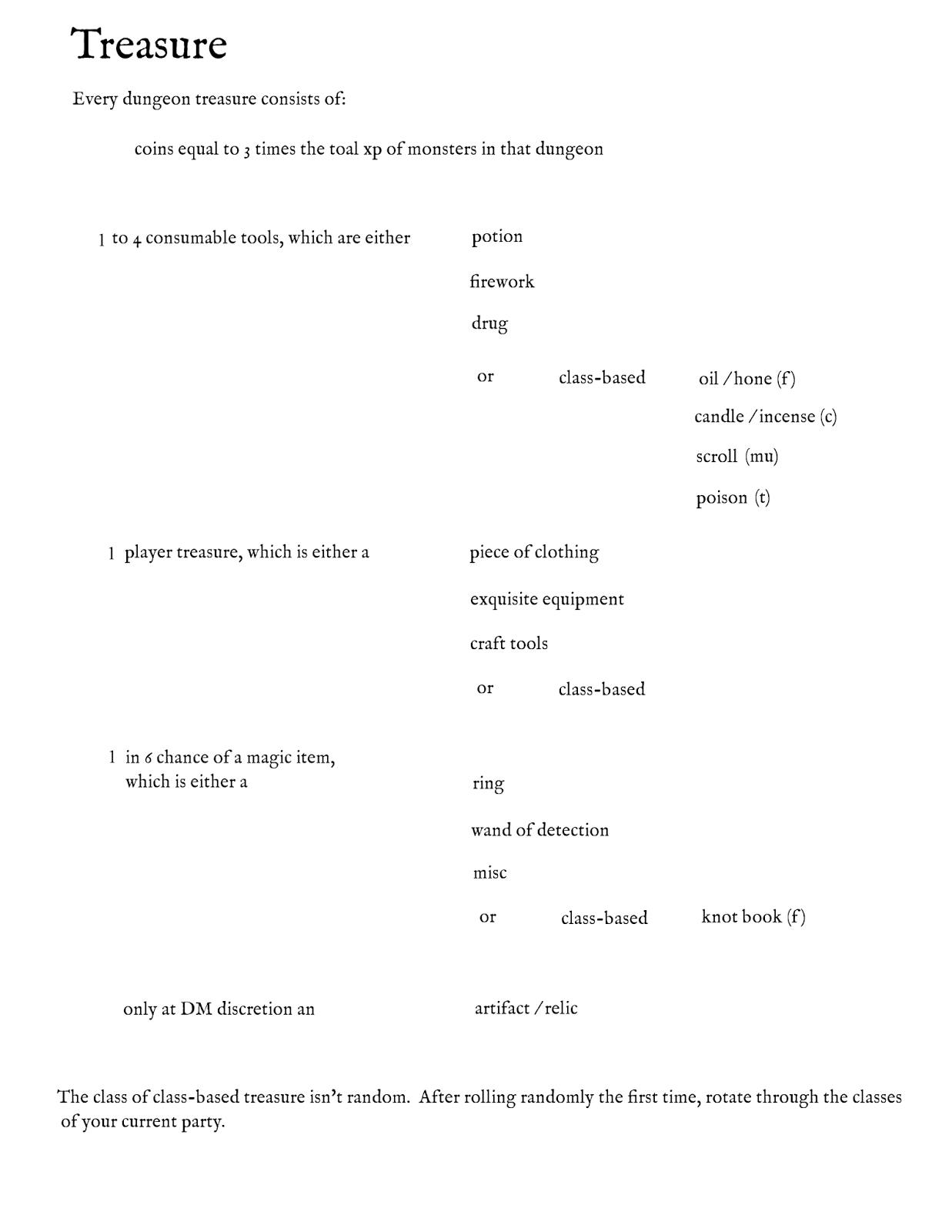
I've spent the last three days fighting LibreOffice and my printer trying to assemble all my treasure tables into something organized that I might share. Haven't succeeded, but in the process I think I have a simple treasure system hammered out now. Here is my attempt to organize the chaos of my many treasure item charts:
How Much Treasure?
The amount of magic treasure you give out will be too much or not enough based on how many players you have and how often you play. But for me, with 4-6 people playing 1-4 times a month, I think this system will work okay. My goal is to get magic into their hands so they can have interesting choices to make and cool plans to come up with using these items. So, 1-4 consumable magic items scattered in every dungeon. I also want treasure to seem cool, more than just money, so at least 1 player valued treasure per dungeon. And a 1 in 6 chance for non-consumable magic items.
Class-Specific Treasures
I think a simple way to make sure all classes present in your campaign get stuff to use is to rotate which class a class-based treasure belongs to. Yes, knowing this might break the sense of realism a bit for a player, but class-based treasures are only one of four things that can be rolled, so they might occur so infrequently players don't notice the rotating pattern. And even if they do, I'm betting it is worth a little gameyness to not randomly end up with magical swords over and over again in treasures found by a party of clerics and magic users.
Birthday Treasures
One curve ball in my treasure allocation process, is that my group and I have a tradition of letting players pick a magic item on their birthday. I think some of the most awesome items my players have, have come from this route. It takes away from the excitement of finding things in the mysterious underworld a bit. But, they only have birthdays once a year, and in our circumstances where our campaign play would sometimes be stopped for long stretches by life it was a way to get some magic items in play. And they love it. So, not sure I would recommend it as a general practice, but it is an option that seems to be working out okay for us.
Work to Do
So, I have most of the charts needed for my system. I still need some class-based consumables for clerics and fighters. I put my idea of what could work for those in my chart-- weapon/armor oils for fighters and candles/incense for clerics seem to fit well. I also need to work on more permanent class-based magic items. A place to start might be One-Page type charts that gather the most iconic magic swords into one place, same for shields. Or just invent more. And yes, still haven't finished the player valued treasure tables. I will try to share these as I finish them.
Showing posts with label Design. Show all posts
Friday, July 29, 2016
Wednesday, June 18, 2014
Generating Ideas
Scott asked about how I generate my ideas in connection with my sandbox wonders series so I thought I might talk a bit about that and come up with some wonders with you. I'm not an expert but I have to do some of this at work and I've done my fair share of tables, so maybe it will be useful.
Constraints
It's counter-intuitive, but putting constraints or boundaries on a topic is helpful. If I were just generating interesting things to encounter in a sandbox I wouldn't know where to start. But the first couple posts of this series I actually laid out a bunch of boundaries for what I wanted: wonders that evoke awe, aren't deadly, have a system to them, grant souvenirs worth gathering, etc. Each can be a springboard for my mind. If I can't think of something that evokes awe I can try to think of locations that might offer interesting souvenirs.
How do you take advantage of this? Because really, most things you'll be trying to generate will come with their own constraints. Well, it could mean trying to narrow down the category of what you want to come up with, say interesting coin treasures instead of just treasures in general. But you could also impose artificial constraints, like only things starting with "G" to help you out.
So, how about now? What is a wonder that starts with "G." The first thing that comes to mind is "graves." But if we go back to the constraint of having souvenirs I think of leaves. Maybe each grave is under a tree and taking the leaves of a particular one will do something for you. What would the system be? Well, we could make the trees cycles through the seasons quickly so you would have to catch them at the right time, but with graves I like the idea that each buried person would offer different boons/banes and you would need to make a choice.
Patterns
Once you start producing ideas, you can look for patterns in them that you can then use to come up with even more ideas. For the wonders I quickly noticed some I'd come up with dealt with water or fire, the elements, and so tried to specifically come up with new wonders that were earth-based or air-based. I also noticed I had a bunch of forest-based wonders and tried to think of some that would work in other biomes or regions of the sandbox: desert, swamp, mountain-top, ocean. In a way recognizing a pattern is giving yourself a new constraint that comes from within the ideas you've already come up with.
I've found that opposites can be a kind of basic pattern to look for. All of your wonders consist of something natural? Maybe we can come up with something made by human hands. I've been trying to avoid the works of people because they bring with them a lot of assumptions about your gameworld's history. But maybe we could keep it simple. How about huge boulders carved into natural towers, dotted around the countryside? What system might they have if they are so scattered? Maybe something will appear in each of them in turn, like a flame or a light.
Another thing you can do is combine patterns, which is a way of turning them into a constraint. So, if we wanted an elemental earth type wonder that would appear in a swamp, what could that be? It isn't really earth, but the first thing that comes to mind is a huge tusk emerging from the muck. What systems could be involved with this? Perhaps the light shining on different parts of it at different parts of the day-- aha, its scrimshawed and if the when the light falls on a certain part of the story magical flowers blossom around the base.
Associative Leaps
This whole post is based on the idea of logically figuring out how we generate things and then using it. But our minds can be complex. If I say "Apple" you may think of the fruit or the company; we each have different associations with various words based on our experiences. But how do we tap into this if it isn't logical, just our mind leaping from one thing to another? Well, to allow for it. Write down lists of things and don't worry too much if they fit the constraints you set at first, just let stuff come. Sometimes a stupid, completely useless idea is one leap away from something great.
While I have moved the order of wonders about a bit, they are mostly in the order I thought of them, so if you look at the whole list (and my list of city wonders too) closely you can see how my mind leapt from one thing to the next.
So how about we try "Apple"? I think of the fruit and worms and seeds in it. Worms make me think of huge petrified things or the worm-like tunnels of volcanic activity now I'm thinking that a volcano is producing apples, except they are smooth obsidian orbs. Okay how about at a certain time of day a local volcano rains down perfectly smooth, spherical or tear-shaped bits of obsidian the size of a human head and these are highly sought as scrying devices, but deadly when raining down.
Inspiration
I hate the word inspiration. It's usually used in a magical or religious sense, like we just have to sit around and wait until a good idea hits us. Obviously I don't agree. But it is true that you need to see and experience things to come up with fresh ideas. My wonders are really limited by my own experiences in the Sierras (probably too many tree-based wonders). If I could visit somewhere else I guarantee I could come up with some fresh angles.
Another thing I would put under this category though is ideas coming from others. I was taught by my culture that ideas are a kind of property that are made by individuals and unique to them. Which if you look around a bit is hogwash. Similar contexts often lead to similar ideas and no idea comes from a vacuum-- your ideas are coming from the stew of stuff in your mind-- all you've read, heard, and seen. So basically, if I want ideas I'm not afraid to make it a social thing and ask others and bounce ideas off them. To that end, I've asked all my friends and most of my employees "You're walking through the woods and you see something that fills you with wonder. What is it?"
I'm still essential to the generating process, because they don't understand all my goals and constraints. If they give me something, invariably I have to shape it a bit. For example, my brother's answer was "a beaver." What!? I think he meant as a suburban human he'd never seen one in the flesh and as cut off from nature as we are it would be pretty wondrous to see one. Our characters in a fantasy world won't have that problem. So what do I do with it? What if it isn't a beaver, but their handiwork? How about a section of forest with the trees carved in the crude likenesses of people? What would the system be? Maybe you go there, then that night the beavers carve you into a new tree, then there is a boon/bane attached to you for a certain amount of time.
Incremental Improvement
You don't have to get the whole idea on the first go. In this post I've the kernels for 5 more wonders but I don't have all the details. I can let them sit for a few days and then look at them again, shifting details to fit my goals better, coming up with the benefits they give players (which is a separate act of generation in itself). But even after I post them, I can decide later that one isn't a good fit and cut it for a better, more newly generated wonder. Generating isn't a single-sitting performance, it is a goal you are working towards and any little step you make towards your goals are valuable revisions.
The Brain is a Muscle
The more we do this kind of generating, the easier it is to produce things in these ways. But there are limits. There are times when I don't have a single idea of a wonder left in my head and had to shift to doing other thing while that part of my brain recharged.
Constraints
It's counter-intuitive, but putting constraints or boundaries on a topic is helpful. If I were just generating interesting things to encounter in a sandbox I wouldn't know where to start. But the first couple posts of this series I actually laid out a bunch of boundaries for what I wanted: wonders that evoke awe, aren't deadly, have a system to them, grant souvenirs worth gathering, etc. Each can be a springboard for my mind. If I can't think of something that evokes awe I can try to think of locations that might offer interesting souvenirs.
How do you take advantage of this? Because really, most things you'll be trying to generate will come with their own constraints. Well, it could mean trying to narrow down the category of what you want to come up with, say interesting coin treasures instead of just treasures in general. But you could also impose artificial constraints, like only things starting with "G" to help you out.
So, how about now? What is a wonder that starts with "G." The first thing that comes to mind is "graves." But if we go back to the constraint of having souvenirs I think of leaves. Maybe each grave is under a tree and taking the leaves of a particular one will do something for you. What would the system be? Well, we could make the trees cycles through the seasons quickly so you would have to catch them at the right time, but with graves I like the idea that each buried person would offer different boons/banes and you would need to make a choice.
Patterns
Once you start producing ideas, you can look for patterns in them that you can then use to come up with even more ideas. For the wonders I quickly noticed some I'd come up with dealt with water or fire, the elements, and so tried to specifically come up with new wonders that were earth-based or air-based. I also noticed I had a bunch of forest-based wonders and tried to think of some that would work in other biomes or regions of the sandbox: desert, swamp, mountain-top, ocean. In a way recognizing a pattern is giving yourself a new constraint that comes from within the ideas you've already come up with.
I've found that opposites can be a kind of basic pattern to look for. All of your wonders consist of something natural? Maybe we can come up with something made by human hands. I've been trying to avoid the works of people because they bring with them a lot of assumptions about your gameworld's history. But maybe we could keep it simple. How about huge boulders carved into natural towers, dotted around the countryside? What system might they have if they are so scattered? Maybe something will appear in each of them in turn, like a flame or a light.
Another thing you can do is combine patterns, which is a way of turning them into a constraint. So, if we wanted an elemental earth type wonder that would appear in a swamp, what could that be? It isn't really earth, but the first thing that comes to mind is a huge tusk emerging from the muck. What systems could be involved with this? Perhaps the light shining on different parts of it at different parts of the day-- aha, its scrimshawed and if the when the light falls on a certain part of the story magical flowers blossom around the base.
Associative Leaps
This whole post is based on the idea of logically figuring out how we generate things and then using it. But our minds can be complex. If I say "Apple" you may think of the fruit or the company; we each have different associations with various words based on our experiences. But how do we tap into this if it isn't logical, just our mind leaping from one thing to another? Well, to allow for it. Write down lists of things and don't worry too much if they fit the constraints you set at first, just let stuff come. Sometimes a stupid, completely useless idea is one leap away from something great.
While I have moved the order of wonders about a bit, they are mostly in the order I thought of them, so if you look at the whole list (and my list of city wonders too) closely you can see how my mind leapt from one thing to the next.
So how about we try "Apple"? I think of the fruit and worms and seeds in it. Worms make me think of huge petrified things or the worm-like tunnels of volcanic activity now I'm thinking that a volcano is producing apples, except they are smooth obsidian orbs. Okay how about at a certain time of day a local volcano rains down perfectly smooth, spherical or tear-shaped bits of obsidian the size of a human head and these are highly sought as scrying devices, but deadly when raining down.
Inspiration
I hate the word inspiration. It's usually used in a magical or religious sense, like we just have to sit around and wait until a good idea hits us. Obviously I don't agree. But it is true that you need to see and experience things to come up with fresh ideas. My wonders are really limited by my own experiences in the Sierras (probably too many tree-based wonders). If I could visit somewhere else I guarantee I could come up with some fresh angles.
Another thing I would put under this category though is ideas coming from others. I was taught by my culture that ideas are a kind of property that are made by individuals and unique to them. Which if you look around a bit is hogwash. Similar contexts often lead to similar ideas and no idea comes from a vacuum-- your ideas are coming from the stew of stuff in your mind-- all you've read, heard, and seen. So basically, if I want ideas I'm not afraid to make it a social thing and ask others and bounce ideas off them. To that end, I've asked all my friends and most of my employees "You're walking through the woods and you see something that fills you with wonder. What is it?"
I'm still essential to the generating process, because they don't understand all my goals and constraints. If they give me something, invariably I have to shape it a bit. For example, my brother's answer was "a beaver." What!? I think he meant as a suburban human he'd never seen one in the flesh and as cut off from nature as we are it would be pretty wondrous to see one. Our characters in a fantasy world won't have that problem. So what do I do with it? What if it isn't a beaver, but their handiwork? How about a section of forest with the trees carved in the crude likenesses of people? What would the system be? Maybe you go there, then that night the beavers carve you into a new tree, then there is a boon/bane attached to you for a certain amount of time.
Incremental Improvement
You don't have to get the whole idea on the first go. In this post I've the kernels for 5 more wonders but I don't have all the details. I can let them sit for a few days and then look at them again, shifting details to fit my goals better, coming up with the benefits they give players (which is a separate act of generation in itself). But even after I post them, I can decide later that one isn't a good fit and cut it for a better, more newly generated wonder. Generating isn't a single-sitting performance, it is a goal you are working towards and any little step you make towards your goals are valuable revisions.
The Brain is a Muscle
The more we do this kind of generating, the easier it is to produce things in these ways. But there are limits. There are times when I don't have a single idea of a wonder left in my head and had to shift to doing other thing while that part of my brain recharged.
Labels:
Constraints,
Design,
Generating,
Wonders
Monday, May 19, 2014
A Pile of Gear
You're down and out. You heard a recent landslide uncovered a rumored tomb location. You and folks you know from sitting outside the alehouse gather all the gear you can and throw it in a pile. Decide how to share it out before heading off to find you fortune:
_____________________________________________________________________
I'm DMing ~7 folks from my work today. Only two of them have any experience with D&Ds. I thought I might try this as a new way of starting out. The cards will be cut up and put on the table between them in a pile. They'll be asked to sort it out, no rules as to how many each character gets except encumbrance*
You've probably heard of fast packs. I never really liked them for the same reason I don't like pregens, they sacrifice player choice for expediency. My solution over the years has been a compromise between those two goals. You can see my forms here. I gave players a pre-made character sheet that has a basic set of gear, like food, water, bedroll-- no use spending valuable time on boring stuff like that-- and then had them make a few limited choices about weapons and other typical dungeon gear like rope and torches. Money wasn't involved.
This has worked fairly well, it's fast, gear is limited enough to be important, and players get to make some choices. One aspect that it isn't good at is thinking about the gear the group as a whole might need. Players tend to make individual choices. With my more experienced players an outgoing player might start quarterbacking "I'll get a lantern, who is getting rope?" I tried solving this by making a record sheet for the party as a whole, but that was just an extra step and quickly forgotten once play started.
I thought I'd try the method above this time. Players can assume they have waterskins and some bread and cheese, maybe, but nothing else. The party as a whole will need to decide who gets the few precious bits of armor, the best weapons and, the few shields. Hopefully this will also get them thinking about the roles each of them will play in their expedition.
I hope for a more desperate, gritty feel to the first dungeon delve. I'm hoping this won't feel too constraining or boardgamey. I plan to include some armor and weapons in the dungeon that players will be able to immediately use.
*Also, I read recently on a blog about "strength-based encumbrance." I can't remember where. That phrase intrigued me, encumbrance has always been affected by strength. So I thought, does it mean encumbrance derived simply from the STR stat? Interesting, I'll try that. So today I'll try an even simpler encumbrance system than the one I've been using: You can carry a number of things equal to half your strength. Armor and weapons are included in those things. We'll see how it goes, but I'm hoping this will make hireling bearers and pack animals much more real as the game progresses.
_____________________________________________________________________
I'm DMing ~7 folks from my work today. Only two of them have any experience with D&Ds. I thought I might try this as a new way of starting out. The cards will be cut up and put on the table between them in a pile. They'll be asked to sort it out, no rules as to how many each character gets except encumbrance*
You've probably heard of fast packs. I never really liked them for the same reason I don't like pregens, they sacrifice player choice for expediency. My solution over the years has been a compromise between those two goals. You can see my forms here. I gave players a pre-made character sheet that has a basic set of gear, like food, water, bedroll-- no use spending valuable time on boring stuff like that-- and then had them make a few limited choices about weapons and other typical dungeon gear like rope and torches. Money wasn't involved.
This has worked fairly well, it's fast, gear is limited enough to be important, and players get to make some choices. One aspect that it isn't good at is thinking about the gear the group as a whole might need. Players tend to make individual choices. With my more experienced players an outgoing player might start quarterbacking "I'll get a lantern, who is getting rope?" I tried solving this by making a record sheet for the party as a whole, but that was just an extra step and quickly forgotten once play started.
I thought I'd try the method above this time. Players can assume they have waterskins and some bread and cheese, maybe, but nothing else. The party as a whole will need to decide who gets the few precious bits of armor, the best weapons and, the few shields. Hopefully this will also get them thinking about the roles each of them will play in their expedition.
I hope for a more desperate, gritty feel to the first dungeon delve. I'm hoping this won't feel too constraining or boardgamey. I plan to include some armor and weapons in the dungeon that players will be able to immediately use.
*Also, I read recently on a blog about "strength-based encumbrance." I can't remember where. That phrase intrigued me, encumbrance has always been affected by strength. So I thought, does it mean encumbrance derived simply from the STR stat? Interesting, I'll try that. So today I'll try an even simpler encumbrance system than the one I've been using: You can carry a number of things equal to half your strength. Armor and weapons are included in those things. We'll see how it goes, but I'm hoping this will make hireling bearers and pack animals much more real as the game progresses.
Wednesday, May 7, 2014
The D&D Campsite
People gathered around a fire is as old as us. To cook and eat, to talk and rest and keep the night at bay until the sun returns again. But, traditionally, the campsite in D&D only exists to give Vancian spellcasters a chance to reload their magazines. With no mechanics for fatigue or hunger or comfort, players might just push on and travel all night if it didn't feel so fundamentally off for us humans.
Actually, one other mechanic has made the campsite more real in the game, the three watches and the chance of attack. But this is just the wilderness impinging on the campsite. And with how abstract wilderness travel in the game tends to be, camp turns out to be just another set of encounter rolls; a single choice about who will be up when the attack in the night comes.
I want campsites to be more than that. To me they are the extension of the hearth into the wilderness and only if they feel that way, a bit safe, a bit like what we've left behind, will attacks in the night be jarring. But even if we decide to never roll for attacks in the night again, I think the comfort of camp can be a contrast that helps bring out the work and danger of traveling through the mountains and swamps, and dark forests. And really, down into the mythic underworld.
Around the campfire is where characters share what they've heard of the dread place they're traveling to and what they miss about home. But for this to happen in our shared, imagined world, I think we have to provide some mechanics that try to make it feel like a campfire and hopefully give players a few interesting choices as well.
So what mechanics? As usual, I'm aiming for brutal simplicity; the least bookkeeping and calculating possible that still gets the job done. Here are a few houserules that might make a campsite feel more real in an adventure game:
Food & Drink
Most characters have rations, or hardtack, or trailbread. Cooking fresh food would make a fire important and camping for the night more of an event. I say +1 hp per level per night in camp when you are eating freshly prepared food. This really works if you have a simple hunting and gathering system. Which in turns makes different landscapes feel more tangible because they have more or less game available. (I'm still hammering out the kinks in my own. See here for it's origins ) But, even without hunting it means stopping in villages and buying or raiding for livestock becomes a reality. On long expeditions players may even want to take livestock with them.
Music
Music in the wilderness means you are not afraid of being attacked and what reminds characters of home more than the songs of home. +1hp per level per night in camp where music is played. The idea came for having bards as hirelings, but I've allowed characters to buy and play their own instrument. This costs some money and takes up encumbrance space. And how about the noise? I wouldn't want to penalize too much, or players would never play music in camp, maybe just a +1 to encounter rolls.
Gear
If you have a system of wear and tear for armor and weapons, camp becomes a place to hone and oil blades, tighten grips, and polish armor. See this post for Brendan's simple equipment deterioration system and here for how I would tie it to the campsite.
Stories
I think one aspect of campfires that makes them what they are is the stories told around them. One approximation of stories could be rumors. We could use camp as an opportunity to introduce rumors from hirelings "My gran all used to say . . .?" But I also like the idea of giving players a chance to make up stories of their own. The problem is some players will be more comfortable doing so than others, but as long as one person can manage a goofy or spooky tale maybe it would be fun enough to implement. How about story responsibility rotates through the players, one each camp night (it is an abstraction meant to stand in for lots of talk) and if the player pulls off one then everyone will receive a +2 to saves made in the location the story was told about. So, for multi-day travels through the wilderness it might not be a big loss to skip the story, but the night before reaching the dungeon or the dread location, it would be worth an effort to come up with something. Rotating through the players allows shy or reluctant players time to think up something or get suggestions from other players.
The Hearth
If the campfire is the extension of the hearth, maybe it should offer some protection against the dark. I'll repost an idea here:
Stars & Weather
This is an idea that just occurred to me. It seems that when we camp is when we notice the sky. I'm sure this is more because we live in post-industrial places with tons of light pollution, but then we are the players of this game. So, what would looking at the stars do? Maybe a chance of auguries, like comets or supernovas. Maybe some kind of weather mini-game that would determine or allow affecting the weather of the next days travel. Maybe a place for the DM to parcel out little bits of campaign world lore "That constellation is called the Hag because . . ." I don't know, something to think about.
In General
Once you introduce the campsite and these mechanics, they become things you can leverage as class knowledge or feats gained by level. Here is a post where I do some of that for fighters. Undamaged gear shown attention might get bonuses. Special recipes are something characters can learn and can give bonuses above general food gathered or hunted. Bonuses for well chosen sites, and even time to reorganize packed gear can become tasks with meaning in the game.
Actually, one other mechanic has made the campsite more real in the game, the three watches and the chance of attack. But this is just the wilderness impinging on the campsite. And with how abstract wilderness travel in the game tends to be, camp turns out to be just another set of encounter rolls; a single choice about who will be up when the attack in the night comes.
I want campsites to be more than that. To me they are the extension of the hearth into the wilderness and only if they feel that way, a bit safe, a bit like what we've left behind, will attacks in the night be jarring. But even if we decide to never roll for attacks in the night again, I think the comfort of camp can be a contrast that helps bring out the work and danger of traveling through the mountains and swamps, and dark forests. And really, down into the mythic underworld.
Around the campfire is where characters share what they've heard of the dread place they're traveling to and what they miss about home. But for this to happen in our shared, imagined world, I think we have to provide some mechanics that try to make it feel like a campfire and hopefully give players a few interesting choices as well.
So what mechanics? As usual, I'm aiming for brutal simplicity; the least bookkeeping and calculating possible that still gets the job done. Here are a few houserules that might make a campsite feel more real in an adventure game:
Food & Drink
Most characters have rations, or hardtack, or trailbread. Cooking fresh food would make a fire important and camping for the night more of an event. I say +1 hp per level per night in camp when you are eating freshly prepared food. This really works if you have a simple hunting and gathering system. Which in turns makes different landscapes feel more tangible because they have more or less game available. (I'm still hammering out the kinks in my own. See here for it's origins ) But, even without hunting it means stopping in villages and buying or raiding for livestock becomes a reality. On long expeditions players may even want to take livestock with them.
Music
Music in the wilderness means you are not afraid of being attacked and what reminds characters of home more than the songs of home. +1hp per level per night in camp where music is played. The idea came for having bards as hirelings, but I've allowed characters to buy and play their own instrument. This costs some money and takes up encumbrance space. And how about the noise? I wouldn't want to penalize too much, or players would never play music in camp, maybe just a +1 to encounter rolls.
Gear
If you have a system of wear and tear for armor and weapons, camp becomes a place to hone and oil blades, tighten grips, and polish armor. See this post for Brendan's simple equipment deterioration system and here for how I would tie it to the campsite.
Stories
I think one aspect of campfires that makes them what they are is the stories told around them. One approximation of stories could be rumors. We could use camp as an opportunity to introduce rumors from hirelings "My gran all used to say . . .?" But I also like the idea of giving players a chance to make up stories of their own. The problem is some players will be more comfortable doing so than others, but as long as one person can manage a goofy or spooky tale maybe it would be fun enough to implement. How about story responsibility rotates through the players, one each camp night (it is an abstraction meant to stand in for lots of talk) and if the player pulls off one then everyone will receive a +2 to saves made in the location the story was told about. So, for multi-day travels through the wilderness it might not be a big loss to skip the story, but the night before reaching the dungeon or the dread location, it would be worth an effort to come up with something. Rotating through the players allows shy or reluctant players time to think up something or get suggestions from other players.
The Hearth
If the campfire is the extension of the hearth, maybe it should offer some protection against the dark. I'll repost an idea here:
A cleric, or anyone versed in the Old Ways, can take a stone weighing a half-stone or more from the night's fire. By incorporating it into the next night's fire ring they make that fire a hearth. Each night of doing so makes the hearth magic stronger. Undead and shape changers can not enter the light of a true hearth.Half-stone is ~7 pounds which is one of my simple encumbrance slots. I'm not interested in the bookkeeping part now. Maybe just, using the hearth a second time on gives the protection, but skipping a use in a fire will mean you have to break the stone in again. Particularly old stones taken from ruins or abandoned cottages might function as magic items that give extra bonuses.
Stars & Weather
This is an idea that just occurred to me. It seems that when we camp is when we notice the sky. I'm sure this is more because we live in post-industrial places with tons of light pollution, but then we are the players of this game. So, what would looking at the stars do? Maybe a chance of auguries, like comets or supernovas. Maybe some kind of weather mini-game that would determine or allow affecting the weather of the next days travel. Maybe a place for the DM to parcel out little bits of campaign world lore "That constellation is called the Hag because . . ." I don't know, something to think about.
In General
Once you introduce the campsite and these mechanics, they become things you can leverage as class knowledge or feats gained by level. Here is a post where I do some of that for fighters. Undamaged gear shown attention might get bonuses. Special recipes are something characters can learn and can give bonuses above general food gathered or hunted. Bonuses for well chosen sites, and even time to reorganize packed gear can become tasks with meaning in the game.
Tuesday, April 29, 2014
Sandbox Lessons from Westeros
I finally got around to reading the books of A Song of Ice and Fire at the insistence of one of my players. I'm not quite done with the last book currently out, but I've enjoyed them quite a bit. I think Martin has done a good job of providing plots that both provide for genre expectations at the same time as surprising me every now and again.
Anyway, as with anything I approached the books with the eyes of a DM and I found some simplifications Martin adopted to help him tell his stories that might also help DMs trying to run players in a big, imagined world. Some simplifications you might consider for your fantasy world:
Anything you would add?
Anyway, as with anything I approached the books with the eyes of a DM and I found some simplifications Martin adopted to help him tell his stories that might also help DMs trying to run players in a big, imagined world. Some simplifications you might consider for your fantasy world:
- Simple Family Names - There are some allegiances in the books that are complicated by marriage, but most are related to your immediate family and families in the books are clear because they have the same last name. Bastards are also clearly marked by a traditional last name, and marked in such a way that you know where their family is from (Snow, Rivers). This allows you to have a lot more characters floating about with out losing track of where they are from and where their allegiances most likely lie. (Many, though not all, of the place names in the books function in similarly simple ways: Oldtown, King's Landing, Winterfell, Riverrun).
- Simple Coats of Arms - Along the same lines, heraldry is simple and almost always utilizes an object appropriate to the location and vocation of that family. And soldiers wear badges of these arms. So you can usually tell just by looking who different troops belong to. That's the point of heraldry, but in real life it is much more complicated. I think that for many of the arms of Westeros players might even be able to guess where the family hails from without former knowledge.
- Simple Long Range Communication - Ravens - By sending message via the ravens, word of deaths and crimes can spread relatively quickly. And while uncertainty of arrival is always mentioned as a possibility, it's never been a plot point in what I've read so far. So, in effect, the castles become points of civilization where news is heard and only someone traveling between them won't be privy to important goings on. Individuals can also send messages, using the ravens like a mail system. This means you don't have to have a complicated system to track the spread of news based on travel times of merchants or peasants, just have ravens carry the news and get on with the show.
- Assumed Knowledge NPCs - Maesters - Every castle has a source of history, technology, and healing. And because of their vows, these maesters while serving that family, are generally neutral and not seeking power or wealth of their own. Have a wound or question about historic lore-- head for a castle. Priests are a similar resource, a septa or septon in every castle, but because of the low magic beginning of the series, they are less important in the books. It might be more important in your world that every castle has a chapel and a priest.
- Assumed Dumping spot for troublesome NPCs - The Night Watch - It seems a neutral faction with its own military but concerns other than ruling, might be handy for many reasons. Having an order to put criminals or potential threats to succession in means these threats never disappear, can be questioned by players, and can become threats again if they break their vows. Also, the faction can be a place for players to look for aid, if it aligns with the order's goals.
Anything you would add?
Sunday, April 27, 2014
Collaborative World Building
I've had my players in this little sandbox for a while and needed a larger world outside of it. I am not good at this because of indecisiveness and wanting to keep the infinite possibilities of an unwritten world as long as possible. So finally I just asked my players to help. I took a big piece of paper, cut it in four and asked them to draw some land.
They asked me about scale. I told them ,"yeah, I don't know, don't worry about it."
After each of them had drawn some territory I had them pass their maps to another person and draw places people might want to live. They were adding more features than I had intended. I just needed help with some geography and where cities would be located but they were putting strange portals, ghosts, cave entrances, etc.
So I took there maps home and treated them as if they were folk maps, I mean that I made the scale much larger than their images seemed to show, because I wanted more than just four little sandboxes.
I traced the major features and tried to interpret some of them. Nicely enough, they had included some swamp, coastal marshes, mountains, forests and deserts, so there was geographic variety. There was also ocean on a few of the maps that I interpreted as a central sea. Here is what is what my interpretation looks like:
The scale is about 30 miles to the inch. Don't know how realistic or game efficient that is but it seems good enough.
Putting it into Play
That took me about 2 weeks to get around to doing. Then this Friday was one of my players birthday. He asked if we could play using the map they had drawn parts of. So I wracked my brain for a way to try and have a session that might tie into this newly made landscape. I finally decided it might be fun to just give the some free mobility like I talked about in this post. So I basically gave them a hot air balloon. It is called the Wicker Tower, has an encumbrance limit and a magical stove that uses meat as fuel (so they have to land every now and then to hunt).
I used the elephant encumbrance sheet I had lying around. It is 20' tall and 15' in diameter. The boxes along the edge are hit points. The six boxes in the middle represent the weight of one person and all their gear or the equivalent. My players thought I did this explicitly to strip them of their hirelings (no, just trying to make them have to make choices, I'd actually forgotten how many total hirelings this party had).
Geographic Wonders in the World
On the wicker tower they found a corpse with some pages from a book and the map above. I've been wanting to try Beedo's awesome idea of the Library of de la Torre for a long time. Unfortunately I don't have all the cool rumors, dungeon locations, etc. that it requires, but I did have a bunch of wonders written up that hopefully might seem interesting enough to visit. So that's what was on the pages, a selection of my wonders that worked well with some of the features my players had included.
I always have fun making physical game props. For this I used the cool font mentioned in this post. I printed them on heavy paper, folded them, soaked them in coffee and then dried them in the oven. Each entry has a symbol next to it that corresponds to a place on the map. Though some share the same symbol, so it can be unclear which wonder is at one of a few locations. Some also have question marks because the location may be uncertain.
Cities and their Rulers
Okay, so I brought those things but I also asked them to do a bit more collaborative work on game night. I had picked 6 locations from their maps to represent big cities and had them roll up stats for the cities as in this post of Zak's. I still have to interpret all the results, there was actually an 18 for trade for the city nearest the party, so they were excited about that and are heading there next. Then I had them all roll up characteristics of the leaders of each of these cities using my hireling trait chart. Again, I need to digest that a bit but there were some promising results.
Balloon Flying Mini-game
One other thing I did, was try to see if it were fun or interesting to try a mini-game that you don't know the rules to. I was trying to mimic the process of learning a skill in real life. The balloon the players wanted to fly had four sets of pullies. I gave four players a d4, d6, and d8. They had to secretly roll the three and choose one as their result. Then I would look at all those and tell them which direction the balloon was going. Then they would roll again and try to direct it where they wanted, but they could only say "higher" or "lower" to each other. The idea was that they had to figure out which pattern made the balloon go in a particular direction, then manage that pattern without communicating to much. It was okay, nothing spectacular. I intend to forget about it once they get a hang of flying in a wind, then we'll all assume they've learned to work it reliably.
In the end, it was a pretty fun way to make a fantasy landscape and then put it into play. Now I need to go look at Vornheim again and come up with a map for this city they are going to.
They asked me about scale. I told them ,"yeah, I don't know, don't worry about it."
After each of them had drawn some territory I had them pass their maps to another person and draw places people might want to live. They were adding more features than I had intended. I just needed help with some geography and where cities would be located but they were putting strange portals, ghosts, cave entrances, etc.
So I took there maps home and treated them as if they were folk maps, I mean that I made the scale much larger than their images seemed to show, because I wanted more than just four little sandboxes.
I traced the major features and tried to interpret some of them. Nicely enough, they had included some swamp, coastal marshes, mountains, forests and deserts, so there was geographic variety. There was also ocean on a few of the maps that I interpreted as a central sea. Here is what is what my interpretation looks like:
The scale is about 30 miles to the inch. Don't know how realistic or game efficient that is but it seems good enough.
Putting it into Play
That took me about 2 weeks to get around to doing. Then this Friday was one of my players birthday. He asked if we could play using the map they had drawn parts of. So I wracked my brain for a way to try and have a session that might tie into this newly made landscape. I finally decided it might be fun to just give the some free mobility like I talked about in this post. So I basically gave them a hot air balloon. It is called the Wicker Tower, has an encumbrance limit and a magical stove that uses meat as fuel (so they have to land every now and then to hunt).
I used the elephant encumbrance sheet I had lying around. It is 20' tall and 15' in diameter. The boxes along the edge are hit points. The six boxes in the middle represent the weight of one person and all their gear or the equivalent. My players thought I did this explicitly to strip them of their hirelings (no, just trying to make them have to make choices, I'd actually forgotten how many total hirelings this party had).
Geographic Wonders in the World
On the wicker tower they found a corpse with some pages from a book and the map above. I've been wanting to try Beedo's awesome idea of the Library of de la Torre for a long time. Unfortunately I don't have all the cool rumors, dungeon locations, etc. that it requires, but I did have a bunch of wonders written up that hopefully might seem interesting enough to visit. So that's what was on the pages, a selection of my wonders that worked well with some of the features my players had included.
I always have fun making physical game props. For this I used the cool font mentioned in this post. I printed them on heavy paper, folded them, soaked them in coffee and then dried them in the oven. Each entry has a symbol next to it that corresponds to a place on the map. Though some share the same symbol, so it can be unclear which wonder is at one of a few locations. Some also have question marks because the location may be uncertain.
Cities and their Rulers
Okay, so I brought those things but I also asked them to do a bit more collaborative work on game night. I had picked 6 locations from their maps to represent big cities and had them roll up stats for the cities as in this post of Zak's. I still have to interpret all the results, there was actually an 18 for trade for the city nearest the party, so they were excited about that and are heading there next. Then I had them all roll up characteristics of the leaders of each of these cities using my hireling trait chart. Again, I need to digest that a bit but there were some promising results.
Balloon Flying Mini-game
One other thing I did, was try to see if it were fun or interesting to try a mini-game that you don't know the rules to. I was trying to mimic the process of learning a skill in real life. The balloon the players wanted to fly had four sets of pullies. I gave four players a d4, d6, and d8. They had to secretly roll the three and choose one as their result. Then I would look at all those and tell them which direction the balloon was going. Then they would roll again and try to direct it where they wanted, but they could only say "higher" or "lower" to each other. The idea was that they had to figure out which pattern made the balloon go in a particular direction, then manage that pattern without communicating to much. It was okay, nothing spectacular. I intend to forget about it once they get a hang of flying in a wind, then we'll all assume they've learned to work it reliably.
In the end, it was a pretty fun way to make a fantasy landscape and then put it into play. Now I need to go look at Vornheim again and come up with a map for this city they are going to.
Labels:
Collaboration,
Design,
DMing,
Maps,
Wilderness,
Wonders
Wednesday, March 26, 2014
Monster Themes
In this recent post I tried to find a way to flesh out and differentiate monsters that have similar mechanical undercarriages. It didn't work that well. Now I'm thinking the simplest approach might be to just pick a theme and apply that to the different monster behaviors.
Here are some simple themes:
Monster Themes
Let's try a few.
What about "Faerie"? What would vermin be in that context? How about little faeries themselves, flitting just out of reach until there is a large enough gathering of them that they are bold enough to attack. That's pretty predictable, how about little bluebirds that fly in and peck you, or butterflies that swarm you and start putting you to sleep with their touch.
What about "Magic"? Magic vermin might be blink rats that teleport to your shoulder and start chewing your ear off. Or maybe even more magic, little, floating orbs that sizzle with energy and sting when they touch. Or maybe a snake that cycles into a rat into spider and back again. Or maybe that would be more suited to Chaos.
In the end, this isn't giving us the specific monster-making help I would like, but it may be the best possible. Why am I posting this now? Because we'll need this table for the next step in making our dungeon together.
Here are some simple themes:
Monster Themes
- Ancient
- Cave
- Chaos
- Disease
- Faerie
- Insect
- Magic
- Prehistoric
- Reptile
- Evil of __________
Let's try a few.
What about "Faerie"? What would vermin be in that context? How about little faeries themselves, flitting just out of reach until there is a large enough gathering of them that they are bold enough to attack. That's pretty predictable, how about little bluebirds that fly in and peck you, or butterflies that swarm you and start putting you to sleep with their touch.
What about "Magic"? Magic vermin might be blink rats that teleport to your shoulder and start chewing your ear off. Or maybe even more magic, little, floating orbs that sizzle with energy and sting when they touch. Or maybe a snake that cycles into a rat into spider and back again. Or maybe that would be more suited to Chaos.
In the end, this isn't giving us the specific monster-making help I would like, but it may be the best possible. Why am I posting this now? Because we'll need this table for the next step in making our dungeon together.
Tuesday, March 25, 2014
Let's Make a Dungeon - Map
Want to make a dungeon with me? I'll show you a method that is quick and easy and yet still a good stand in for natural caverns. If you get tripped up on your own perfectionism or are just too tired from work to make a dungeon come game night, this is dedicated to you. I'll break this up into several posts because blogging about the process actually takes longer than using it. So, today we'll just do the map.
Get 12 dice of various shapes. Make about half of them visually distinguishable from the rest. I chose dark and light:
Toss the dice on the paper. If some roll off the paper just move them back to the closest edge:
I use blank paper but if you feel more comfortable using graph paper go right ahead.
Now trace the dice in pencil as you remove them and write down the number they rolled. Light, sloppy, and fast is good. If several dice clump together, trace around all of them like its one lumpy room. Also put a little dot for the dark dice:
Now, draw connections from odd numbers to odd and from even numbers to even. Not all of them have to connect but try to avoid a a simple circle. or completely linear arrangement:
If there is no connection between the even and odd caverns you'll need to arbitrarily make one. (luckily, our clumpy room connects the 3 even elevation rooms here.)
Now, clean up the connecting passages and draw little curved lines to indicate differences in elevation. I draw them like little steps leading from the lower areas to the higher, each indicating a rise of 10'. If a difference is too much, make it a sharp cliff:
Now, those dotted areas where the dark dice fell are "Fat Man's Misery" type passages, they're passable, but just barely. Characters will either have to crawl on their bellies, or sidle along sideways. The chambers can be very low-ceilinged or choked with stalagmites. (I decided to make the passage from the elevation 3 room to elevation 13 very narrow, and make the 1, 3, 10 elevation rooms with dots have low ceilings)
One last thing. If we roll a 12 sider and just count clockwise (roughly) to pick a room, we can place a water source and see what it does. If there are lower elevations nearby, let it flow along. If not, it can be a pool, or you can disregard- not every cave has to have water.
The largest numbers are the exits to the surface. So, here the 15 and 13 have entrances from surface caves or sinkholes.
Now we have some treacherous terrain to explore: narrow passages, long drops (one 60', one 100'), and even a dry cave hidden by a nearly impassable underwater one. Next we'll place some monsters.
Get 12 dice of various shapes. Make about half of them visually distinguishable from the rest. I chose dark and light:
| Whoops, my d10 with the dark 7 should be on the other side |
Toss the dice on the paper. If some roll off the paper just move them back to the closest edge:
I use blank paper but if you feel more comfortable using graph paper go right ahead.
Now trace the dice in pencil as you remove them and write down the number they rolled. Light, sloppy, and fast is good. If several dice clump together, trace around all of them like its one lumpy room. Also put a little dot for the dark dice:
Now, draw connections from odd numbers to odd and from even numbers to even. Not all of them have to connect but try to avoid a a simple circle. or completely linear arrangement:
If there is no connection between the even and odd caverns you'll need to arbitrarily make one. (luckily, our clumpy room connects the 3 even elevation rooms here.)
Now, clean up the connecting passages and draw little curved lines to indicate differences in elevation. I draw them like little steps leading from the lower areas to the higher, each indicating a rise of 10'. If a difference is too much, make it a sharp cliff:
Now, those dotted areas where the dark dice fell are "Fat Man's Misery" type passages, they're passable, but just barely. Characters will either have to crawl on their bellies, or sidle along sideways. The chambers can be very low-ceilinged or choked with stalagmites. (I decided to make the passage from the elevation 3 room to elevation 13 very narrow, and make the 1, 3, 10 elevation rooms with dots have low ceilings)
One last thing. If we roll a 12 sider and just count clockwise (roughly) to pick a room, we can place a water source and see what it does. If there are lower elevations nearby, let it flow along. If not, it can be a pool, or you can disregard- not every cave has to have water.
The largest numbers are the exits to the surface. So, here the 15 and 13 have entrances from surface caves or sinkholes.
Now we have some treacherous terrain to explore: narrow passages, long drops (one 60', one 100'), and even a dry cave hidden by a nearly impassable underwater one. Next we'll place some monsters.
Labels:
caves,
Design,
DIY,
Dungeons,
Generating,
Maps,
Toss-n-Trace
Sunday, March 16, 2014
Creepy Vermin
I mentioned in this post that I could use the behavior categories also as a kind of template, so, as a base, vermin have giant rats stats by default, and then I can differentiate them from there. I've been thinking since that post about about how to do this.
Someone might call this "fluff" but, to me, this is where much of the game lies. If I can freak out my friends just by describing what is slithering towards them, I'm happy. Also, just mechanically, there isn't much range of damage or hit dice you can give creatures and keep them within the same dangerousness. I mean, start giving giant rats 2 HD and they are no longer vermin, they start functioning as some other kind of dungeon monster. So, in the end, a lot of creatures, unless you've given them a cool special ability, will be palette swaps for previously encountered creatures.
Anyway, on to what I came up with. I started by trying to come up with a list of adjectives that might describe what I consider creepy or verminous. I made a chart. Then I thought it might be simpler and more strightforward to just combine creepy critters, so I made a second chart. I'll show you that second one first because I don't think it works as well:
You can see above that I tried a second draft of this chart. I cut bat and leech, because mouse/pigeon in my mind is much like a bat, and worm and leech seemed too close as well.
Again, I still didn't like the results much; how much different from a centipede is a worm/centipede or a maggot/centipede for that matter. I think the problem is that too many characteristics that ick us out are packaged into each verminous thing and we need to tease some of them out to get more possible, and novel, combinations.
I think now, that a way to fix this might be to have the creepy stuff in one column and then fuzzy-pet stuff in the other (you could get like maggot-kitten hybrids, ick) Anyway, I just wanted to share it with you so you could see my process. So, now back to the first attempt I mentioned:
I'm thinking now another possible column would be to add a "target," because an easy avenue to body horror is to tell you the thing is crawling toward your ear or burrowing into your armpit.
Anyway, let's try a few:
8, 9 , 2
Naked skin, it glides, and has teeth, okay maybe flying cave squirrels. Or to try and get weirder, hairless Chihuahuas that bark continuously and glide at you with little needle teeth.
8, 8, 4
Okay that's kind of gross, it looks like a hairless hamster with a long proboscis and it will hop suddenly and try to plunge it into you and suck your juices.
2, 5, 6
This is scaly like a small lizard and it moves on shaky legs like it is sick or dying but it has a stinger on its belly.
5, 5, 3
This is slimy and shaky, sound like a newborn. So, maybe this looks like a newborn puppy that shakily approaches with eyes closed and then pounces with sharp claws.
Not too bad. I might use some of those. One of my players is a dog groomer and I think having new-born puppy-things following her around the dungeon trying to do her harm might freak her out.
It doesn't completely solve my problem because I have scavengers and pack creatures to worry about too, but it's a start.
Someone might call this "fluff" but, to me, this is where much of the game lies. If I can freak out my friends just by describing what is slithering towards them, I'm happy. Also, just mechanically, there isn't much range of damage or hit dice you can give creatures and keep them within the same dangerousness. I mean, start giving giant rats 2 HD and they are no longer vermin, they start functioning as some other kind of dungeon monster. So, in the end, a lot of creatures, unless you've given them a cool special ability, will be palette swaps for previously encountered creatures.
Anyway, on to what I came up with. I started by trying to come up with a list of adjectives that might describe what I consider creepy or verminous. I made a chart. Then I thought it might be simpler and more strightforward to just combine creepy critters, so I made a second chart. I'll show you that second one first because I don't think it works as well:
You can see above that I tried a second draft of this chart. I cut bat and leech, because mouse/pigeon in my mind is much like a bat, and worm and leech seemed too close as well.
Again, I still didn't like the results much; how much different from a centipede is a worm/centipede or a maggot/centipede for that matter. I think the problem is that too many characteristics that ick us out are packaged into each verminous thing and we need to tease some of them out to get more possible, and novel, combinations.
I think now, that a way to fix this might be to have the creepy stuff in one column and then fuzzy-pet stuff in the other (you could get like maggot-kitten hybrids, ick) Anyway, I just wanted to share it with you so you could see my process. So, now back to the first attempt I mentioned:
I'm thinking now another possible column would be to add a "target," because an easy avenue to body horror is to tell you the thing is crawling toward your ear or burrowing into your armpit.
Anyway, let's try a few:
8, 9 , 2
Naked skin, it glides, and has teeth, okay maybe flying cave squirrels. Or to try and get weirder, hairless Chihuahuas that bark continuously and glide at you with little needle teeth.
8, 8, 4
Okay that's kind of gross, it looks like a hairless hamster with a long proboscis and it will hop suddenly and try to plunge it into you and suck your juices.
2, 5, 6
This is scaly like a small lizard and it moves on shaky legs like it is sick or dying but it has a stinger on its belly.
5, 5, 3
This is slimy and shaky, sound like a newborn. So, maybe this looks like a newborn puppy that shakily approaches with eyes closed and then pounces with sharp claws.
Not too bad. I might use some of those. One of my players is a dog groomer and I think having new-born puppy-things following her around the dungeon trying to do her harm might freak her out.
It doesn't completely solve my problem because I have scavengers and pack creatures to worry about too, but it's a start.
Sunday, January 26, 2014
5 OSR Table Types
Happy Birthday D&D! I remember the moment I first heard of the game. My friend was excitedly telling me about it on the playground of our elementary school. A game with knights and dragons and treasure. I remember the first thing I asked him was "Does it have witches?" So, from the very first, the gift D&D gave me was more the knowledge that you could play a game based in your imagination than a particular incarnation of rules. And I immediately wanted to make things myself to add and use in the game. In that spirit I'd like to celebrate 40 years of D&D by sharing with you cool stuff I learned in just the last 4 years of blogging hoping that you will find it useful in making your own stuff.
First, I'm working from an understanding of the game that considers randomness essential to play. The dice remove responsibility from the DM to know and plan everything and they give the game a sense life in the way their unexpected results surprise and must be dealt with. Those dice work most commonly by interacting with tables of possibilities. And the possibilities of what you can do with those tables are a lot more exciting than simple lists. I'll show 5 below.
Another assumption I'm making is that you are doing it yourself, and when you re making your own tables, the more possibilities you can get from them the better. So, many of these "Tables" actually involve multiple subtables greatly multiplying the possible outcomes. The problem with that is they become ungainly, hard to fit even on one page, hard to use quickly or during play. So, the tables below are mostly trying to resolve that problem: how do you pack in as many crazy possibilities as possible in a table while still keeping it useful as a tool?
I would be surprised if some of these kinds of tables hadn't shown up back in the heyday of D&D, but as a very enthusiastic hobbyist, I never saw them. Feel free to point out examples of these I might have missed in old products or even other table types you've seen in the community.
Roll All the Dice
Years ago now, James R. "Grim" Cone posted a random NPC generator online. You can still get it and two other tables of his here. The innovation was that the dice types would help you keep track of the subtables. But also it acknowledged that the amount of space you need for good results on a subtable varies.
It can also be fun to resolve at the table , by players. I praised it in a post way back here and have created several of them. The one I use most often is probably my Hireling Traits linked in my sidebar.
So if you find yourself making a table and you can't squeeze everything you want into a single list, try laying out 6 lists with 4 to 20 entries and see if that works better. Then pick a set of dice with a bright, easy-to-find color so you can grab them all when you need them. And let your players roll and read out the results.
Sentence Sub-Tables
Okay, this isn't really a different table type but this simple innovation really helped think about my own tables differently and makes them much easier to understand when explaining to players. Chris Hogan from Vaults of Nagoh posted a few roll all the dice tables that had a sentence up top with the subtables embedded as words in that sentence. This showed how the subtables worked together.
The sentence in the image at right is basically the dice in order of magnitude, but they don't have to be.
I see blogposts to this day that would benefit from this kind of simple overview of what subtables to expect. And, in looking, I realize I never added this to my older tables like hireling traits. I'll have to do that.
Dice Drop
I think I probably encountered these first from Talysman's The Nine & Thirty Kingdoms where he calls them dice maps, but you may be most familiar with those that show up on ZakS' Vornheim covers. He calls them die drop tables. Both of them have been sharing ideas with blog readers for years of how to use the positions dice fall on a paper as well as their numerical results to squeeze out more information with the same effort.
(The images here are just examples I picked from the many they've posted to their blogs.)
When you roll dice they are going to fall somewhere, so why not use that info as well as the numbers on their faces to tell you something?
This can be efficient in telling you a lot fast, it can also be a showy way to have players roll up things. One aspect I've also tried to explore is the "fuzziness" of the positions. In other words, trying to use where the dice fall in an evocative way to push my thinking. I tried that with my item generator here.
These tables probably aren't the most useful, the dice have a way of running off the table, for example, and putting these in a box to prevent that undermines the ability of players to see results, but they are fun and this kind of coming at D&D from a new angle is what keeps me excited and writing blog posts.
Graduated
I don't have an example of this type, which I just made up the name for. I also haven't made one of my own yet. But it's been banging around in my brain for a long time waiting for the right table. (It looks like I was thinking about it way back here and called the idea "stepped charts.") Link me some good examples in the comments.
Basically this is a single table designed to give graduated results depending what type of die you use to roll on it. So, for a critical hit results table the first four results on the table might be the mildest, and the 20th or 100th the very worst. And then built into your critical hit rules would be calls for rolling different dice on that single table. (Now I'm remembering one that gave results for random encounters during the day and night. But I don't remember where I saw it.)
This type of table is interesting because there will be some results that are impossible to get during certain contexts. They would probably be most useful for determining random things that often have different contexts, like monster encounter tables, without needing to make bunches of tables. Night time, bad weather, making lots of noise, being wounded, these all bump you up to worse results.
Update 1/28/14: Okay, some sweet examples from the comments: here James Young has being resurrected at higher levels doing different things. Here scrap princess has drugs doing graduated results based on exploding dice, which very cleverly means the more drugs you take the more likely you bump up the results. And here scrap princess has linear and bell distributions preferencing different parts of a table.
Layered
I don't know which of Roger the GS' posts first clued me in to this type of table, it might have been his genre tables. But the idea is, you have one table that can act as one table, but has multiple subtable parts that can each be rolled on independently as well. This blew my mind, because it solves the problem of trying to include the old standby genre-standard results you might want for any table, while allowing for mixing and matching those parts into something weirdly new.
In a way, this is like a graduated result controlled by the DM's understanding of the context. Playing with a group of newbies? Why not let them experience some things we might consider rpg cliches? Playing with a more experienced group or getting a result the newbies have experienced several times now, tumble those subtables.
I incorporated this idea in my own Traps table (notice I've incorporated Chris' sentence idea on that one) and have it foremost in my brain when making a new random table.
Bonus Ideas
Buffers - I never saw a published random table with more entries than could be indicated with a die or set of dice. But I've liked the idea that a) some entries you might not want to have come up more than that one time in your campaign, so you scratch it out and replace it with an entry from the overflow results and b) folks will have different tastes and it's hard to predict which results any one person will find cool. My 100 Rare Wonders actually has 110 entries. Since it's more work, this more about sharing and tables you make with other people in mind.
Mix-n-match - I've had an idea for a long time for a way to use sets of subtables to build different tables to roll on based on context. The idea in my head is magical effect that can be applied to a player. You have many subtables of types of effects and whenever you make new dungeon with a migic pool or statue or something, you can tailor the effects those cause by your choice of subtables that you assemble. I blogged about it here. The 1e system of artifact effects is kiiiind of like this, if they were more about determining random effects for for artifacts in-game and not just determining a single static effect that artifact has beforehand.
p.s. - Am I the only one that has always interchangeably called these random doohickeys tables and charts? I had to keep catching myself in this post to remain consistent.
Update 1/28/14
Toss & Trace
This isn't what I normally think of when I think "table" but Josh W is absolutely right, this is like the opposite side of the coin of the dice drop table. Here you drop the dice and then create something based on where it fell and its result. Josh mentions How to Host a Dungeon, which I don't own. But this technique is near and dear to my heart, it's how I make most of my cave dungeon maps. This technique really shines when you want to make something that is more organic in its placement like caves or cottages in a village.
Here is my pyramid campsite which uses four-siders to get a simple topographical map of where the party is camping. Here's my post about making caves. I learned later to use the dice results to indicate elevation and even/odd to help me determine which caves are connected to each other with tunnels.
1d30 used this technique to make the scattered buildings of a village. Check out the Babbling Bane's use of pocket change to make a village here.
Bonus 2
JD has kind of flipped the idea of the graduated table, rather than multiple ways to read a single table, multiple ways to read a single toss of the dice, here.
I love all the examples from the comments, thank you so much. There are probably tons of cool tables I've seen but now forgotten, if so I apologize for not mentioning them here.
Wouldn't it be cool if D&D Next used some of these kinds of tables? They are simple to use and I think even simple conceptually. So I don't see it hard for players to use. They do take more work to make though. The layered tables, for example, require a good sense of the core aspects of what you are making a table for (like classic treasure items, or classic trap types) and ways to divide them up into columns that will lead to fruitful results when rolled separately.
Update 1/30/14
Split Column
This is similar to the Layered table, but I think different enough in intent to be considered a different type. It is essentially reducing the clutter and confusion of multiple little tables by associating them together. Zak shows how to consolidate small tables here. So, each of Jeremy's sub-tables can be incorporated into a single table that is easy to read across. For a simple, fast result you roll 1d6, or to mix up things you can roll all 5d6 and read the tables individually. Zak's Vornheim uses this several times and makes for efficient generation in limited space. Why have 50 aristocrat names, when you can split first and last into two columns anddouble multiply the possibilities. Why have a big list of npc details when you know you will want several details for each npc encountered in-game. Instead have a split column chart with three details per npc entry and you can always roll them separately if you need to.
How is this different than what I called layered? Well, it would be layered if the fast, simple result was a core trope, or genre expectation you wanted to make sure was possible to generate, and the rest were weird and unexpected. I makes more sense for some topics than others. Treasure items, traps, quests, might all have some results you might like to have possible with weirdoid results possible too.
Ah, it might be splitting hairs. If it helps you make more useful tables in the end I'll be happy.
First, I'm working from an understanding of the game that considers randomness essential to play. The dice remove responsibility from the DM to know and plan everything and they give the game a sense life in the way their unexpected results surprise and must be dealt with. Those dice work most commonly by interacting with tables of possibilities. And the possibilities of what you can do with those tables are a lot more exciting than simple lists. I'll show 5 below.
Another assumption I'm making is that you are doing it yourself, and when you re making your own tables, the more possibilities you can get from them the better. So, many of these "Tables" actually involve multiple subtables greatly multiplying the possible outcomes. The problem with that is they become ungainly, hard to fit even on one page, hard to use quickly or during play. So, the tables below are mostly trying to resolve that problem: how do you pack in as many crazy possibilities as possible in a table while still keeping it useful as a tool?
I would be surprised if some of these kinds of tables hadn't shown up back in the heyday of D&D, but as a very enthusiastic hobbyist, I never saw them. Feel free to point out examples of these I might have missed in old products or even other table types you've seen in the community.
Roll All the Dice
Years ago now, James R. "Grim" Cone posted a random NPC generator online. You can still get it and two other tables of his here. The innovation was that the dice types would help you keep track of the subtables. But also it acknowledged that the amount of space you need for good results on a subtable varies.
It can also be fun to resolve at the table , by players. I praised it in a post way back here and have created several of them. The one I use most often is probably my Hireling Traits linked in my sidebar.
So if you find yourself making a table and you can't squeeze everything you want into a single list, try laying out 6 lists with 4 to 20 entries and see if that works better. Then pick a set of dice with a bright, easy-to-find color so you can grab them all when you need them. And let your players roll and read out the results.
Sentence Sub-Tables
Okay, this isn't really a different table type but this simple innovation really helped think about my own tables differently and makes them much easier to understand when explaining to players. Chris Hogan from Vaults of Nagoh posted a few roll all the dice tables that had a sentence up top with the subtables embedded as words in that sentence. This showed how the subtables worked together.
The sentence in the image at right is basically the dice in order of magnitude, but they don't have to be.
I see blogposts to this day that would benefit from this kind of simple overview of what subtables to expect. And, in looking, I realize I never added this to my older tables like hireling traits. I'll have to do that.
Dice Drop
I think I probably encountered these first from Talysman's The Nine & Thirty Kingdoms where he calls them dice maps, but you may be most familiar with those that show up on ZakS' Vornheim covers. He calls them die drop tables. Both of them have been sharing ideas with blog readers for years of how to use the positions dice fall on a paper as well as their numerical results to squeeze out more information with the same effort.
(The images here are just examples I picked from the many they've posted to their blogs.)
When you roll dice they are going to fall somewhere, so why not use that info as well as the numbers on their faces to tell you something?
This can be efficient in telling you a lot fast, it can also be a showy way to have players roll up things. One aspect I've also tried to explore is the "fuzziness" of the positions. In other words, trying to use where the dice fall in an evocative way to push my thinking. I tried that with my item generator here.
These tables probably aren't the most useful, the dice have a way of running off the table, for example, and putting these in a box to prevent that undermines the ability of players to see results, but they are fun and this kind of coming at D&D from a new angle is what keeps me excited and writing blog posts.
Graduated
I don't have an example of this type, which I just made up the name for. I also haven't made one of my own yet. But it's been banging around in my brain for a long time waiting for the right table. (It looks like I was thinking about it way back here and called the idea "stepped charts.") Link me some good examples in the comments.
Basically this is a single table designed to give graduated results depending what type of die you use to roll on it. So, for a critical hit results table the first four results on the table might be the mildest, and the 20th or 100th the very worst. And then built into your critical hit rules would be calls for rolling different dice on that single table. (Now I'm remembering one that gave results for random encounters during the day and night. But I don't remember where I saw it.)
This type of table is interesting because there will be some results that are impossible to get during certain contexts. They would probably be most useful for determining random things that often have different contexts, like monster encounter tables, without needing to make bunches of tables. Night time, bad weather, making lots of noise, being wounded, these all bump you up to worse results.
Update 1/28/14: Okay, some sweet examples from the comments: here James Young has being resurrected at higher levels doing different things. Here scrap princess has drugs doing graduated results based on exploding dice, which very cleverly means the more drugs you take the more likely you bump up the results. And here scrap princess has linear and bell distributions preferencing different parts of a table.
Layered
I don't know which of Roger the GS' posts first clued me in to this type of table, it might have been his genre tables. But the idea is, you have one table that can act as one table, but has multiple subtable parts that can each be rolled on independently as well. This blew my mind, because it solves the problem of trying to include the old standby genre-standard results you might want for any table, while allowing for mixing and matching those parts into something weirdly new.
In a way, this is like a graduated result controlled by the DM's understanding of the context. Playing with a group of newbies? Why not let them experience some things we might consider rpg cliches? Playing with a more experienced group or getting a result the newbies have experienced several times now, tumble those subtables.
I incorporated this idea in my own Traps table (notice I've incorporated Chris' sentence idea on that one) and have it foremost in my brain when making a new random table.
Bonus Ideas
Buffers - I never saw a published random table with more entries than could be indicated with a die or set of dice. But I've liked the idea that a) some entries you might not want to have come up more than that one time in your campaign, so you scratch it out and replace it with an entry from the overflow results and b) folks will have different tastes and it's hard to predict which results any one person will find cool. My 100 Rare Wonders actually has 110 entries. Since it's more work, this more about sharing and tables you make with other people in mind.
Mix-n-match - I've had an idea for a long time for a way to use sets of subtables to build different tables to roll on based on context. The idea in my head is magical effect that can be applied to a player. You have many subtables of types of effects and whenever you make new dungeon with a migic pool or statue or something, you can tailor the effects those cause by your choice of subtables that you assemble. I blogged about it here. The 1e system of artifact effects is kiiiind of like this, if they were more about determining random effects for for artifacts in-game and not just determining a single static effect that artifact has beforehand.
p.s. - Am I the only one that has always interchangeably called these random doohickeys tables and charts? I had to keep catching myself in this post to remain consistent.
Update 1/28/14
Toss & Trace
This isn't what I normally think of when I think "table" but Josh W is absolutely right, this is like the opposite side of the coin of the dice drop table. Here you drop the dice and then create something based on where it fell and its result. Josh mentions How to Host a Dungeon, which I don't own. But this technique is near and dear to my heart, it's how I make most of my cave dungeon maps. This technique really shines when you want to make something that is more organic in its placement like caves or cottages in a village.
Here is my pyramid campsite which uses four-siders to get a simple topographical map of where the party is camping. Here's my post about making caves. I learned later to use the dice results to indicate elevation and even/odd to help me determine which caves are connected to each other with tunnels.
1d30 used this technique to make the scattered buildings of a village. Check out the Babbling Bane's use of pocket change to make a village here.
Bonus 2
JD has kind of flipped the idea of the graduated table, rather than multiple ways to read a single table, multiple ways to read a single toss of the dice, here.
I love all the examples from the comments, thank you so much. There are probably tons of cool tables I've seen but now forgotten, if so I apologize for not mentioning them here.
Wouldn't it be cool if D&D Next used some of these kinds of tables? They are simple to use and I think even simple conceptually. So I don't see it hard for players to use. They do take more work to make though. The layered tables, for example, require a good sense of the core aspects of what you are making a table for (like classic treasure items, or classic trap types) and ways to divide them up into columns that will lead to fruitful results when rolled separately.
Update 1/30/14
Split Column
This is similar to the Layered table, but I think different enough in intent to be considered a different type. It is essentially reducing the clutter and confusion of multiple little tables by associating them together. Zak shows how to consolidate small tables here. So, each of Jeremy's sub-tables can be incorporated into a single table that is easy to read across. For a simple, fast result you roll 1d6, or to mix up things you can roll all 5d6 and read the tables individually. Zak's Vornheim uses this several times and makes for efficient generation in limited space. Why have 50 aristocrat names, when you can split first and last into two columns and
How is this different than what I called layered? Well, it would be layered if the fast, simple result was a core trope, or genre expectation you wanted to make sure was possible to generate, and the rest were weird and unexpected. I makes more sense for some topics than others. Treasure items, traps, quests, might all have some results you might like to have possible with weirdoid results possible too.
Ah, it might be splitting hairs. If it helps you make more useful tables in the end I'll be happy.
Labels:
Charts,
Design,
Dice Drop Chart,
DIY,
Generating,
Tables
Thursday, January 23, 2014
Wonders Worth Exploring For cont.
Sorry for the lame delay, work got busy again. My last post asked what we hope to find when we explore a sandbox. I've been doing some thinking for myself and hoping to come to some general principles that could help us generate stuff.
Scale
My main conclusion so far was that scale doesn't really work as a inducer of wonder in an imagined landscape. The grand canyon is awe inspiring in real life, probably impossible to convey in D&D. Of course, that doesn't mean you can't try. In my own game I had a huge hole in the ground based on the Cave of Swallows and I would show new players a video of someone parachuting into it to try and give them a sense of its size.
A couple other ideas related to scale. I think it is partially personal based on familiarity. If you know rivers and I tell you the dimensions of this fantasy river, its width, speed, depth-- that might have a potential to awe you. Likewise for anything, mountains, pine trees, particular animals. But in general, you wouldn't know as a DM who has enough knowledge to be amazed by the thing you made up.
Also, I noticed that my whole last post seemed to assume wilderness features. Can't wonders be found in a dungeon? I think so, sure, but the very dungeoness of dungeons, their constrained underground space, will make it harder to awe. So in this case scale does seem to matter. A room full of petrified trees is not as impressive as petrified trees as far as the eyes can see. And maybe the underground, being the mythic underworld, is expected to be weird, so something must be that much more impressive to invoke a sense of wonder.
Features of a wonder
Okay, so we have not relying on scale as a feature, what else? Here are some ideas I had:
Something that is a semi-permanent part of a landscape. A miniature city or a tree that has diamonds for fruit might be cool, but the fact you could dig them up and carry them off in a wagon detracts for me their wonder. The wonders we want will be locations players can return to again and again. (I guess, in a sense, this is another way that scale does matter).
That being said, it might be more of a draw in a game if players can take souvenirs-- bits of the landscape, vials of liquid-- that have value or strange properties from these sites.
Odd, but not deadly. Deadly can be awesome too, but I think it is much easier to evoke fear in someone then a sense of wonder and I'm shooting for the latter. So, we'll try to keep them survivable even if they are dangerous.
A toy to use or figure out. Either they have some pattern or system to them or they might have potential uses for players. This doesn't have much to do with wonders more with any building block of a game where players can make choices.
_______________________
Let's start with the elements and go from there:
1. Walking rocks - A great flat plain filled with rocks of various sizes. Each night, they slide along at walking speed in one of the four cardinal directions. They range in size from pebble to huge boulders you could build a keep on. (sort of like sailing stones).
2. The Teeming Plains - Vast plains with many overlapping fossilized tracks. Apparently caused by some near-instant calamity in the ancient past. If you learn to distinguish the tracks you can follow those of mages, warriors, and angels to where they stop, dig there, and find caches of ancient magic left where they died.
3. Everburning Fire - In some far away hollow surrounded by wastelands is a fire that will never go out. It can catch fuels on fire and burn them up, but will remain, burning on the ground even when the fuel is burnt up. Burns in the rain. Burns in the snow. Smothering it might put it out. Have a sentient species of creatures covered in this fire (they just want to be friends) or obsidian trees that blossom with it ever spring.
4. Cold Fires - Found in a crater this fire can be spread by normal fuels - carried on a torch, in a brazier - but will never consume the fuels. It burns underwater. It burns eternally but is not hot.
5. The Great Mirage Lake - A huge, dry, sea. When a water craft is pushed into it water forms all around, lifting it up. This water might be collected in a container from inside the craft.
6. Lesser Mirage Lake - A beautiful blue lake in a dry land. The waters recede from any living thing. It might be possible to catch some with a suitably long pole. It might be possible to explore sunken cities hidden in its deepest parts.
7. The Blanched Moors - Low, wet lands covered with shallow, bitter pools. In these are the perfectly preserved bodies of creatures that have died here, all white. White stallions, white cocks, white apes, albino princesses. Perfect for those searching for material components or extinct beasts to revivify.
8. The Solid Fogs - At certain times of year the mists across some bays coalesce into solid clouds. These are a danger for ships. There are tales of mages gathering the stuff with shovels and saws to place in the air and build towers on.
9. Lethe Fogs - Said to rise from the ground in fell bogs. It smells faintly of over ripe apples and eats away at the memory (lose XP ever day you travel in it). If bottled could cause memory loss in targets elsewhere.
10. The Sweet Wind - A chance wind that arises on a certain lost plain. It smells faintly of vanilla. It clears the air and sharpens those that breathe it (extra XP for anything that grants it bonus chance for checks like casting spells to be successful).
11. The Crowding Grove - A forest of trees that press in on any living thing, becoming impassable. Cuttings and twigs taken will have similar properties.
12. The Shy Thickets - Thick brush that parts for anything living. Plantings can be taken. Might function as a good anti-undead defence.
Okay, some of those don't fulfill all of my own criteria, but hopefully they would be suitably interesting and trippy if encountered by your players. I have a few more ideas, including human-made wonders, for a later post.
Scale
My main conclusion so far was that scale doesn't really work as a inducer of wonder in an imagined landscape. The grand canyon is awe inspiring in real life, probably impossible to convey in D&D. Of course, that doesn't mean you can't try. In my own game I had a huge hole in the ground based on the Cave of Swallows and I would show new players a video of someone parachuting into it to try and give them a sense of its size.
A couple other ideas related to scale. I think it is partially personal based on familiarity. If you know rivers and I tell you the dimensions of this fantasy river, its width, speed, depth-- that might have a potential to awe you. Likewise for anything, mountains, pine trees, particular animals. But in general, you wouldn't know as a DM who has enough knowledge to be amazed by the thing you made up.
Also, I noticed that my whole last post seemed to assume wilderness features. Can't wonders be found in a dungeon? I think so, sure, but the very dungeoness of dungeons, their constrained underground space, will make it harder to awe. So in this case scale does seem to matter. A room full of petrified trees is not as impressive as petrified trees as far as the eyes can see. And maybe the underground, being the mythic underworld, is expected to be weird, so something must be that much more impressive to invoke a sense of wonder.
Features of a wonder
Okay, so we have not relying on scale as a feature, what else? Here are some ideas I had:
Something that is a semi-permanent part of a landscape. A miniature city or a tree that has diamonds for fruit might be cool, but the fact you could dig them up and carry them off in a wagon detracts for me their wonder. The wonders we want will be locations players can return to again and again. (I guess, in a sense, this is another way that scale does matter).
That being said, it might be more of a draw in a game if players can take souvenirs-- bits of the landscape, vials of liquid-- that have value or strange properties from these sites.
Odd, but not deadly. Deadly can be awesome too, but I think it is much easier to evoke fear in someone then a sense of wonder and I'm shooting for the latter. So, we'll try to keep them survivable even if they are dangerous.
A toy to use or figure out. Either they have some pattern or system to them or they might have potential uses for players. This doesn't have much to do with wonders more with any building block of a game where players can make choices.
_______________________
Let's start with the elements and go from there:
1. Walking rocks - A great flat plain filled with rocks of various sizes. Each night, they slide along at walking speed in one of the four cardinal directions. They range in size from pebble to huge boulders you could build a keep on. (sort of like sailing stones).
2. The Teeming Plains - Vast plains with many overlapping fossilized tracks. Apparently caused by some near-instant calamity in the ancient past. If you learn to distinguish the tracks you can follow those of mages, warriors, and angels to where they stop, dig there, and find caches of ancient magic left where they died.
3. Everburning Fire - In some far away hollow surrounded by wastelands is a fire that will never go out. It can catch fuels on fire and burn them up, but will remain, burning on the ground even when the fuel is burnt up. Burns in the rain. Burns in the snow. Smothering it might put it out. Have a sentient species of creatures covered in this fire (they just want to be friends) or obsidian trees that blossom with it ever spring.
4. Cold Fires - Found in a crater this fire can be spread by normal fuels - carried on a torch, in a brazier - but will never consume the fuels. It burns underwater. It burns eternally but is not hot.
5. The Great Mirage Lake - A huge, dry, sea. When a water craft is pushed into it water forms all around, lifting it up. This water might be collected in a container from inside the craft.
6. Lesser Mirage Lake - A beautiful blue lake in a dry land. The waters recede from any living thing. It might be possible to catch some with a suitably long pole. It might be possible to explore sunken cities hidden in its deepest parts.
7. The Blanched Moors - Low, wet lands covered with shallow, bitter pools. In these are the perfectly preserved bodies of creatures that have died here, all white. White stallions, white cocks, white apes, albino princesses. Perfect for those searching for material components or extinct beasts to revivify.
8. The Solid Fogs - At certain times of year the mists across some bays coalesce into solid clouds. These are a danger for ships. There are tales of mages gathering the stuff with shovels and saws to place in the air and build towers on.
9. Lethe Fogs - Said to rise from the ground in fell bogs. It smells faintly of over ripe apples and eats away at the memory (lose XP ever day you travel in it). If bottled could cause memory loss in targets elsewhere.
10. The Sweet Wind - A chance wind that arises on a certain lost plain. It smells faintly of vanilla. It clears the air and sharpens those that breathe it (extra XP for anything that grants it bonus chance for checks like casting spells to be successful).
11. The Crowding Grove - A forest of trees that press in on any living thing, becoming impassable. Cuttings and twigs taken will have similar properties.
12. The Shy Thickets - Thick brush that parts for anything living. Plantings can be taken. Might function as a good anti-undead defence.
Okay, some of those don't fulfill all of my own criteria, but hopefully they would be suitably interesting and trippy if encountered by your players. I have a few more ideas, including human-made wonders, for a later post.
Labels:
Design,
DMing,
Sandbox,
Wilderness,
Wonders
Monday, January 13, 2014
Wonders Worth Exploring For
I love exploring in sandboxes. But what does that mean? What do I-- and you hope to find? I suppose the largest parts of it for me is finding the edges. In this sense, exploring is less about geography and more about understanding how things work. How big is the world? What happens when I reach the edge? If there is a snowy region will I suffer from the cold? Can I swim?
With the last few questions I realize I am mostly thinking about video game sandboxes. Because of the limitations of technology they are never really able to model reality, you have to figure out what this particular sandbox decided to try and model. Can I jump this little fence? Can I break this door? But an RPG sandbox is presumably free of the technological limitations that cause this. Anything in our imaginations is possible. If I want to break the door, or jump the fence I say it and it happens.
Ironically, the freedom of the imagination means we are still uncertain of the world because the RPG sandbox is not required to model the world. Water might burn in this world and all doors made of lead, or dragon scales. Which is fine, because it means there is still the pleasure of figuring the world out. But it does leave us back at the beginning with our first question unanswered. What do we hope to find?
I suppose something that does reveal a bit about how the world works would be one answer. So, if planar travel exists finding a portal and how to use it would fit the bill of understanding the edges of the world. Or, a shrine that allows time travel. Or just examples of what geography is possible- burning seas and crystal forests on one end, and just confirmation that, yes, deserts do exist, on the other.
Because there is a type of pleasure in genre expectations being fulfilled too. So in a world that we get to explore, we will probably want to encounter terrain types that we are familiar with from real stories of exploration: deserts, tall mountains, undersea ruins.
But I think there is more to my desire to explore than that. I think there is a part of me that hopes to be surprised and awed.
One of the difficulties of the RPG sandbox is that although anything is possible, the majority of it will be limited by what we can describe using language. And so the things that might have awed actual explorers like the Grand Canyon or the giant Sequoias, Angel Falls or the Pyramids, are going to be far less impressive when just described. Heck, even standing right beside a giant Sequoia it's hard to perceive its size.
So, I think there are limits to our ability to create awe or wonder through description, at least if we limit ourselves to using sensory details. The imagined wonder might need to be more conceptual.
So not the tallest waterfall, but one that flows backwards, not the biggest tree, but one that grows in a single day. Maybe.
I've been gathering some ideas. I'll share them soon.
With the last few questions I realize I am mostly thinking about video game sandboxes. Because of the limitations of technology they are never really able to model reality, you have to figure out what this particular sandbox decided to try and model. Can I jump this little fence? Can I break this door? But an RPG sandbox is presumably free of the technological limitations that cause this. Anything in our imaginations is possible. If I want to break the door, or jump the fence I say it and it happens.
Ironically, the freedom of the imagination means we are still uncertain of the world because the RPG sandbox is not required to model the world. Water might burn in this world and all doors made of lead, or dragon scales. Which is fine, because it means there is still the pleasure of figuring the world out. But it does leave us back at the beginning with our first question unanswered. What do we hope to find?
I suppose something that does reveal a bit about how the world works would be one answer. So, if planar travel exists finding a portal and how to use it would fit the bill of understanding the edges of the world. Or, a shrine that allows time travel. Or just examples of what geography is possible- burning seas and crystal forests on one end, and just confirmation that, yes, deserts do exist, on the other.
Because there is a type of pleasure in genre expectations being fulfilled too. So in a world that we get to explore, we will probably want to encounter terrain types that we are familiar with from real stories of exploration: deserts, tall mountains, undersea ruins.
But I think there is more to my desire to explore than that. I think there is a part of me that hopes to be surprised and awed.
One of the difficulties of the RPG sandbox is that although anything is possible, the majority of it will be limited by what we can describe using language. And so the things that might have awed actual explorers like the Grand Canyon or the giant Sequoias, Angel Falls or the Pyramids, are going to be far less impressive when just described. Heck, even standing right beside a giant Sequoia it's hard to perceive its size.
So, I think there are limits to our ability to create awe or wonder through description, at least if we limit ourselves to using sensory details. The imagined wonder might need to be more conceptual.
So not the tallest waterfall, but one that flows backwards, not the biggest tree, but one that grows in a single day. Maybe.
I've been gathering some ideas. I'll share them soon.
Labels:
Design,
DMing,
Sandbox,
Wilderness,
Wonders
Monday, December 2, 2013
No-Touch Triggers
I was thinking of weird engines that were powered by things just happening in the vicinity, but it might be more useful to you as a general purpose trigger.
The idea is to set up a fun, mysterious occurrence that players have to figure out what they're doing to cause it. That means the effect, be it boon or bane, shouldn't be too extreme, because you expect it to happen multiple times. Also, the trigger should be something easily discoverable, or frustration will be the only thing triggered.
So, for example, every time someone asks a question in a room a gong sounds and players gain 5 pounds.
This means we need to generate both possible triggers and possible amusing affects. I think the latter is easier and I'll leave it to you. The former is trickier because it balances on the border of in-game and out-of-game actions. I guess the fancy way to put it is that these actions are at least potentially diegetic. They have to be things it is plausible for characters to do even if it is players doing it without thinking about their characters. Here are some possible ones I thought of:
The majority of these are just talking, but most actions would involve touching and are pretty standard dungeon fare, like opening a chest or door triggering something. They would have the mystery of what is causing this. Eating, drinking, praying or reading in the room might work, but then you have to hope players might actually do those things. I suppose it's a fairly niche application. But it could be fun. Let me know if you can think of any potential triggers.
The idea is to set up a fun, mysterious occurrence that players have to figure out what they're doing to cause it. That means the effect, be it boon or bane, shouldn't be too extreme, because you expect it to happen multiple times. Also, the trigger should be something easily discoverable, or frustration will be the only thing triggered.
So, for example, every time someone asks a question in a room a gong sounds and players gain 5 pounds.
This means we need to generate both possible triggers and possible amusing affects. I think the latter is easier and I'll leave it to you. The former is trickier because it balances on the border of in-game and out-of-game actions. I guess the fancy way to put it is that these actions are at least potentially diegetic. They have to be things it is plausible for characters to do even if it is players doing it without thinking about their characters. Here are some possible ones I thought of:
- ask a question
- say a name
- say a direction (n,s,e,w or right, left)
- use a conditional (if we . . . ?, will you . . .?)
- character rests, sits or lies down.
- player eats something (this is clearly out-of-game, but might be funny.. a gong goes off every time someone grabs a pretzel)
The majority of these are just talking, but most actions would involve touching and are pretty standard dungeon fare, like opening a chest or door triggering something. They would have the mystery of what is causing this. Eating, drinking, praying or reading in the room might work, but then you have to hope players might actually do those things. I suppose it's a fairly niche application. But it could be fun. Let me know if you can think of any potential triggers.
Thursday, November 14, 2013
A Familiar Pattern
Over the years I've tried in my creations to utilize objects folks might have at home, like playing cards, poker chips, and dominoes. One of the reasons for this is availability, but the corollary of that is if they are common things people will be pretty familiar and comfortable with them in mini-games or in-game puzzles.
Just yesterday I thought of a familiar pattern I've never seen any one use-- the pattern on a football (soccer ball). The pattern, called a truncated icosahedron, has 12 black pentagonal faces and 20 white hexagonal ones.
I think there is a lot of potential here, though for what I'm not sure yet. We humans have pretty good spacial memories, so if you have a "top" firmly marked it would be pretty easy to remember all the 32 different spots you might interact with, even without numbering or labeling them.
At first I was going to make an angel based on this, using a d4 and a d8 to randomly generate one of the 32 spots. But the more I thought about it, the more I realized there is a quite a bit more potential. For example, each of the hexagons shares sides with three different pentagons. What if these pentagons had certain qualities, heat, light, or whatever and the different hexagons might be the varying combinations of those qualities. I'm thinking weather, or maybe beauty, something with lots of possibilities to fill the 12 black spots.
The more I think about it the more I like it as a possible very simple weather manipulator. And seeing as the Sleestak pylons are one of the weird influences that led to my angels, that would be pretty cool.
I would have preferred to figure an example all out before posting, but I'm anxious to make, share, and converse-- my blog has been quiet too long. If you can come up with a cool use that has 12 qualities interacting, let me know.
Just yesterday I thought of a familiar pattern I've never seen any one use-- the pattern on a football (soccer ball). The pattern, called a truncated icosahedron, has 12 black pentagonal faces and 20 white hexagonal ones.
I think there is a lot of potential here, though for what I'm not sure yet. We humans have pretty good spacial memories, so if you have a "top" firmly marked it would be pretty easy to remember all the 32 different spots you might interact with, even without numbering or labeling them.
At first I was going to make an angel based on this, using a d4 and a d8 to randomly generate one of the 32 spots. But the more I thought about it, the more I realized there is a quite a bit more potential. For example, each of the hexagons shares sides with three different pentagons. What if these pentagons had certain qualities, heat, light, or whatever and the different hexagons might be the varying combinations of those qualities. I'm thinking weather, or maybe beauty, something with lots of possibilities to fill the 12 black spots.
The more I think about it the more I like it as a possible very simple weather manipulator. And seeing as the Sleestak pylons are one of the weird influences that led to my angels, that would be pretty cool.
I would have preferred to figure an example all out before posting, but I'm anxious to make, share, and converse-- my blog has been quiet too long. If you can come up with a cool use that has 12 qualities interacting, let me know.
Monday, September 2, 2013
The Maximalist Dungeon
A few posts back a commenter was not too happy with the push toward minimalism in some parts of our hobby. Since then I've been thinking of what the opposite would look like. And, while it would be easy to be snarky, I want to do this seriously: what would a maximalist dungeon look like? And by that I mean a maximalist dungeon that I, the lover of small and streamlined, would really want to see and use?
I think if you're getting a dungeon from someone else it should be giving you something you can't do yourself, either because you are unable to do it or you don't have the time. This could be several things including ideas you might never have had or DM experience you don't yet have cooked into the design of the place. But I think the two most obvious are drudge work and art work. I'm not an artist so that's something I could get from someone else. And there are plenty of things that might be worth trying at the table but which take so much prep time you never get around to them. Let's think along those lines a bit.
The Maximalist Dungeon could have:
So, yeah, I can envision a module that is a piece of art because of its elegance, how it gives you just what you need to run it and then gets out of your way. But I can also imagine a module that is a piece of art because of its ridiculous abundance, its richness that spills out at you like coins from a coffer.
I think if you're getting a dungeon from someone else it should be giving you something you can't do yourself, either because you are unable to do it or you don't have the time. This could be several things including ideas you might never have had or DM experience you don't yet have cooked into the design of the place. But I think the two most obvious are drudge work and art work. I'm not an artist so that's something I could get from someone else. And there are plenty of things that might be worth trying at the table but which take so much prep time you never get around to them. Let's think along those lines a bit.
The Maximalist Dungeon could have:
- Illustrations of every room. There's precedent with the image booklets in some of the TSR modules like Tomb of Horrors. I think a lot of those were produced because a trap needed visualization, but even just an illustration to show you the decay and layout of the rooms would be cool. As a kid I loved David Macaulay's Motel of the Mysteries and the detailed images of those rooms, in what was essentially a dungeon, unearthed.
- Illustrations of cluttered crime scenes. This is related to the above, because once you have high enough level of detail and once you have illustrations of every room, so that showing an illustration isn't a tip off of importance, you can hide clues in plain sight. Keys, notes, scraps of cloth. I have always been interested in solo play and I remember reading about (but never seeing) a solo gamebeook that had some full page illustrations for this kind of close examination/exploration. If you know what it was called let me know. Of course traps can become more brutal too, if the trip wires or pressure plates are right there in the picture.
- Illustrations of every monster, or at least every new monster. We are limited in our ability to imagine based on things we've seen before. But if you show us a picture your new monster can look like whatever you can draw. If you've followed my blog you know that I've tried to come up with new monsters through lots of different angles. This would be one I haven't tried: something hard to explain or describe but that you can easily understand by looking at a drawing. There could be all kinds of dreamlike, nightmarish, warped possibilities waiting for the right artist to unleash them on us.
- Portraits of every NPC. Without a face players don't have much to remember NPCs by, an accent, a cliched personality. Portraits could help with that. With portraits you could get a sense of class, wealth, general demeanor, scars, familial resemblance etc.
- Illustrations of treasure items. This is pretty simple, one way to make the +1 magic swords unique is to make them look different.
- So these have been about art so far how about the drudge work? Well, related to the NPC portraits above would be NPC personalities fleshed out for all the folks in the adventure/dungeon. I don't think I would personally need a whole backstory, because after a certain length I'm probably not going to read it. But if the background could inform how they act and make choices that would be cool to know. If the person was orphaned and has had to struggle alone they might not like the idea of accepting help, for example, and will become irritated if they can't pay for services.
- Along those lines, if we are dealing with factions, or politics, or romance, illustrated and annotated relationship webs of NPCs would be cool. What is the chain of command? Who will rumors spread to first? Who owes favors to whom? Who do you need to talk to find out intimate details about a particular NPC?
- And of course, going right along with the illustrations of treasure items would be unique treasure items with back stories.
- This is related to having detailed pictures of rooms but takes it one step farther. I've posted before about the idea of a grab bag store room, where everything in a room is on cards, so imagine if you combine a room's illustration, with small illustrated cards that you could hand players when they ask about particular objects or details. There comes a point where this would almost be better suited as a video game with items you can pick up and examine, a whole immersive digital world, but even in those, details are sparse or duplicated because of the work it takes to make things.
- Unique spellbooks is a subset of unique treasure items. And it doesn't have to be a cheesy facsimile, but having some illustration or physical card with the contents for each spell book found would be cool. And, of course, each would have unique spell variations.
- Give me a constructed language and a script or system of runes. I love this stuff, and I think it adds to the atmosphere in a game, but it takes so much time it falls by the way side in my games. But having even something that is little more that pig-latin for goblin inscriptions peppered around the dungeon that players can try and decipher would be fun. Or different aged scripts denoting excursions into a megadungeon at different times, that would be sweet. You want to talk about something that would be cool but I don't do just because of the amount of work, there it is.
- Along the lines of musing I did about sandboxes, it would be interesting to have the locations affected by different times of visit. So, maybe in the wet season this cave is half full of water and there are different creatures here, maybe during festivals this cult encampment has an entirely different population and feel to it. That is in essence asking for multiple modules. Yes. And players are likely to only ever encounter one of these states. Yes. But if you want maximal, that's maximal to me.
- Designer notes is something I don't think I've ever seen. Presumably, if you are selling a dungeon you have run multiple parties through it, multiple times. So, what did those folks do? What choices did they tend to make? I can see not wanting to read this stuff and experiencing my party's choices with them, but I can also see wanting to go back and read how that compares to the other folks that visited here. Designer notes would also be cool just to get a sense of what the maker was trying for and how this module/adventure fits in with their experience and other creations.
- DM notes would be slightly different. I'm thinking tips and advice gained through experience. So, this section of the dungeon is invisible, here's some ideas on how to run that at the table. This monster causes fear, here's a way you might handle what players under the fear power will do. Etc. Obviously this stuff isn't necessary to run a night of D&D, but if you are good enough and experienced enough at designing dungeons to sell me one, one of the assets you have is that experience. So why not share it with me?
So, yeah, I can envision a module that is a piece of art because of its elegance, how it gives you just what you need to run it and then gets out of your way. But I can also imagine a module that is a piece of art because of its ridiculous abundance, its richness that spills out at you like coins from a coffer.
Thursday, August 8, 2013
Visual Dungeon Challenge
Okay, friends, for my 999th post I'm throwing down my glove and offering a challenge to each and every one of you:
Post your attempt to your blog, link in the comments below, or email me, just share your map with us somehow.
This is not a contest. You win if you make a damn attempt. There is no time limit. You can keep making these. I think this should be an interesting exercise for any DM, because it will force you to look very closely at what exactly you require to run a dungeon, and how that may or not be different from what other DMs require.
Here is my first attempt:
I tried to indicate elevation with shades of gray and curved steps. Each step is 10' and the darker it gets the deeper you are. So, for example, the central area has a 90' drop to the right. I think numbers might work better but didn't want them confused with room numbers.
I used a number to distinguish similar icons, so you can distinguish the potions, for example. This will only work for very small dungeons or bare ones. So I might need to come up with symbols for spells to put beside a scroll or for potion affects beside each potion, etc. Though, that sounds very challenging. Rather than use the same technique for the coins symbol, I could just put a number for the amount of coins in the hoard right next to it on the map. Of course that would assume it was a hoard of one coin type or get very cluttered quickly. A lot of problems. But this is all okay, it's why I'm doing this: seeing what the limits are, seeing what is possible.
Now, I'm kind of cheating by telling you all that. But maybe a sentence or two of explanation is okay-- something you might put in an image caption or email to a fellow DM. Like "Roman numerals are NPC level" or "Greek letters are for traps." And certainly we want to hear your thoughts behind your design decisions. You just can't make something that requires a long explanation to be functional.
Good luck.
Make a one page dungeon that uses only images and visual devices. No words. No abbreviations.This is intended to be given to another DM, not a personal bookkeeping system. Because of that it can allow for some customization by the other DM. You can use numbers, roman numerals, or your own invented symbols if you can convey what they mean to someone.
Post your attempt to your blog, link in the comments below, or email me, just share your map with us somehow.
This is not a contest. You win if you make a damn attempt. There is no time limit. You can keep making these. I think this should be an interesting exercise for any DM, because it will force you to look very closely at what exactly you require to run a dungeon, and how that may or not be different from what other DMs require.
Here is my first attempt:
I tried to indicate elevation with shades of gray and curved steps. Each step is 10' and the darker it gets the deeper you are. So, for example, the central area has a 90' drop to the right. I think numbers might work better but didn't want them confused with room numbers.
I used a number to distinguish similar icons, so you can distinguish the potions, for example. This will only work for very small dungeons or bare ones. So I might need to come up with symbols for spells to put beside a scroll or for potion affects beside each potion, etc. Though, that sounds very challenging. Rather than use the same technique for the coins symbol, I could just put a number for the amount of coins in the hoard right next to it on the map. Of course that would assume it was a hoard of one coin type or get very cluttered quickly. A lot of problems. But this is all okay, it's why I'm doing this: seeing what the limits are, seeing what is possible.
Now, I'm kind of cheating by telling you all that. But maybe a sentence or two of explanation is okay-- something you might put in an image caption or email to a fellow DM. Like "Roman numerals are NPC level" or "Greek letters are for traps." And certainly we want to hear your thoughts behind your design decisions. You just can't make something that requires a long explanation to be functional.
Good luck.
Labels:
Design,
Detail,
DMing,
Maps,
One-Page,
Silhouette,
Simplifying,
Tools
Subscribe to:
Posts (Atom)


